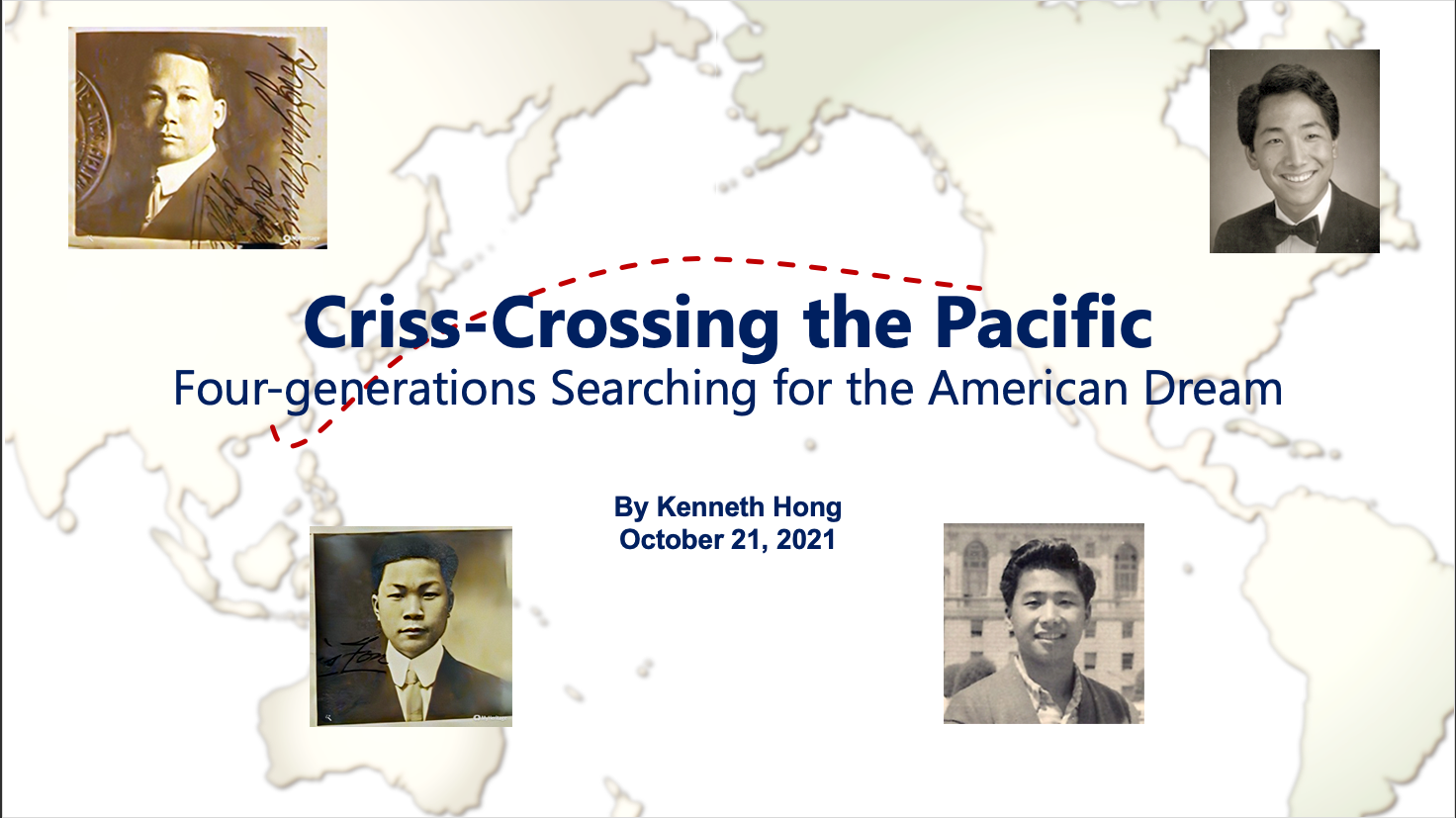
Jack Lan Hong (1933 - 2013)

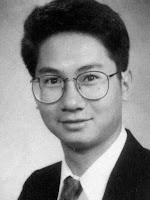
Jack Lan Hong - 1953

Jack Lan Hong (曾連卓) was born in China, Guangdong Province, Toishan County, Ong On Village ( 中國廣東省台山縣東安村), on October 15, 1933, and pass away a month after his 80th birthday, on November 20, 2013 in Redwood City, California. He was the second son of Hong Hock How, a Stanford-trained electrical engineer, educator, and business man, and Tui Goon Chu Hong.

Shortly after he was born, Jack, his parents and older brother Larry moved to Guangzhou, where his brother Paul and sister Lily were born. During China’s war with Japan, the family moved frequently and ended up in Kunming, China. There Jack's youngest sister, Mary, was born and Jack acquired his taste for spicy food. After the war, the family moved to Rangoon, Burma, where the children attended the Wah Sha School.

Growing up in Kunming, China, and Rangoon, Burma

On September 7, 2009, a few weeks before his 76th birthday, Jack recorded his memories of the past 75 years including growing up in Kunming and Burma:

"My earliest memory is in Kunming because that’s where I grew up. I had a classmate who owned a restaurant. Oh maybe, they were Muslim. They didn’t eat pork. When I would show up at their restaurant, they would give me nong. You know the [rice] crust from the big pot. So they also served me beef. I never knew if it was horse meat, because in Kunming they ate a lot of horse meat too.

The Heavy Weight of a Trip to the National Archives

by Kenneth Hong
July 16, 2023

As I wind my way up Interstate 280, I take in the golden hills of California and glimpses of the Bay through the cool fog of an ordinary San Francisco summer morning. Exiting the highway, I drive by the rows of regimented white tombstones of the Golden Gate National Cemetery and up to the gray concrete bunker that is the National Archives. The usual feelings of anticipation build, a mixture of excitement and dread--excitement that I might find something new and dread that I end up with empty folders.

Entrance to the National Archives in San Bruno, CA
July 3, 2023

The Angel Island Files: Mysteries Solved and Found

By Kenneth Hong
July 16, 2023

Over the last 4th of July week, I spent a day and a half at the U.S. National Archives in San Bruno, CA, where many of the Chinese Exclusion Era immigration files from the Angel Island Immigration Station are kept. The archivist had located the files for my maternal grandfather (Chin Pak Yick), his father (Chin Gay Bin), his wives (Lee Moon Yee and Tso Mee Shew), and his famous first cousin (Chin Lain).

   
Lee Moon Yee, 1918
An "entirely respectable Chinese woman"
    Chin Pak Yick, 1918
"Well-dressed in American Clothes"

I had previously written about all five of these relatives. All but my grandmother Tse Mee Shew had died long before I was born, and in the case of my great-grandfather, Lee Moon Yee, and Chin Lain, before my mother was born. When I asked her or other relatives, "What do you know about your grandfather, father, or his first wife?" I would get only vague recollections about their father, and nothing about the other two.

I Owe My Life to Wong Kim Ark

By Kenneth Hong
May 30, 2023

The threads of history are woven together in unexpected ways. My family's story is inextricably linked to that of a man who fought for his rights as a U.S. citizen. A man whose name I had never heard of until a few years ago. I owe my very existence to that man named Wong Kim Ark.

Wong was born on Sacramento Street in San Francisco in 1870. My great-grandfather, HONG Yin Ming was born a few blocks away on Washington Street that same year.* We don't know whether or not they ever met, but they lived almost identical lives.

Identification Photo of Wong Kim Ark
 on 1904 Immigration Affidavit
(National Archives)
Identification Photo of Hong Yin Ming
 on 1899 Immigration Affidavit
(National Archives)

Official Map of San Francisco Chinatown 1885, with
Sacramento and Washington Streets Highlighted

Keep reading to learn more about Wong's legacy and how it affected Hong Yin Ming and his descendants.

Remembering Fred Chin (1943 - 2022)

Fred CHIN Bo Hing 陳寶興 was born in Oakland, California, on August 17, 1943 to CHIN Pak Yick and TSO Mee Shew, the sixteenth of his father Pak Yick's seventeen children, and the fifth of Mee Shew's six. Fred passed away on Tuesday, December 27, 2022 at age 79 at his home in Danville, California where he lived with his partner Lee Chen.
Fred Chin and Lee Chen, December 23, 2022

Fred grew-up in the family's home on 7th Street in Oakland Chinatown. Although his family did not have a lot of money, their home was filled with a lot of love and the Chin’s all worked together to get through lean times. Throughout his school years, Fred enjoyed playing basketball, football, and many other sports.

Fred (Center) in 1945 
with siblings (L-R) Rose, Dennis, Mabel and Allen

Looking back, his brother Dennis recalls that Fred was a good student, getting all A’s and B’s, especially in Math and Science. Freddie wanted to take a Chemistry class, but it was full so he ended up having to take a laboratory tech class instead.
Fred (bottom 2nd from left)
Lincoln Junior High School
6th Grade Photo

William S. Chin (1931 - ) Memories of Growing Up in Oakland, California

William S. Chin, 1959

My maternal uncle William Bo Shang Chin 陳寶瑺 was born in the Oakland, California on January 5, 1931, to Chin Pak Yick 陳伯釴 and Lee Moon Yee 李滿意. He was the youngest of their 11 children. Moon Yee died in 1933 a month before William's 3rd birthday. Pak Yick re-married in 1936, and William has two half-sisters (including my mother) and four half-brothers from that marriage.

Uncle Bill made the following submission for a project called "Memories of Growing Up in Oakland, California: Lincoln School Alumni". The project, published on September 24, 2010, encapsulates both family and school photos, individual memories, newspaper clippings and more covering 1370 pages. William's brothers Morris and Allen and sister-in-law Diane Lee (Chin) also had individual submissions.

* The Lincoln School is one of the oldest schools in the Oakland Unified School District. The first Lincoln School was created in 1874 when the Harrison Primary School at 10th and Alice Streets was renamed. It was the main primary school for generations of students from Oakland Chinatown and the surrounding area. It has had several incarnations and occupied different buildings. It was a 1-8th grade school during the time William's father attended in the 1910's and a K-9th grade school by the time William attended in the 1930s and 40s. The current Lincoln Elementary School teaches kindergarten through 5th grade students, and is located at 225 11th Street in Oakland, California.

Morris D. Chin (1927-2018): In His Own Words

My material Uncle Morris Bo Doong Chin 陳寶琮 was born in the San Francisco, California on September 14, 1927, to Chin Pak Yick 陳伯釴 and Lee Moon Yee 李滿意. He passed away at the age of 90 on June 29, 2018, in Oakland, California.

He made the following submission for a project called "Memories of Growing Up in Oakland, California: Lincoln School Alumni". The project has over 1300 photos and entries starting from around 1920.

The Hong Family: Recollections on Serving the Community

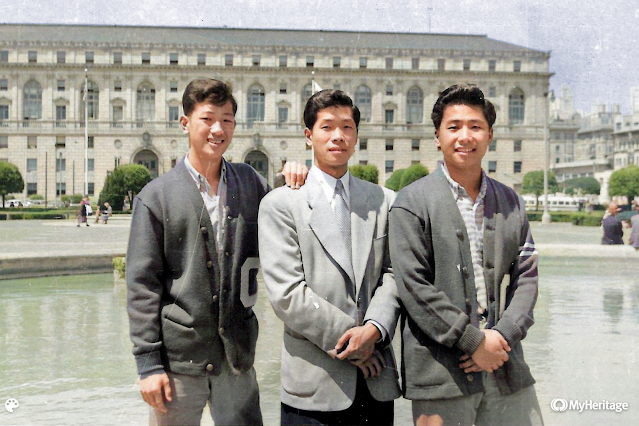
1951 San Francisco Civic Center Plaza - Paul, Larry, and Jack Hong
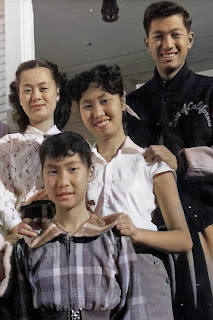
1955 San Francisco Richmond District
(L-R) Sister-in-law Marie Chu,
Mary, Lily, and Paul Hong

     My father, Jack, and his four siblings, Larry, Paul, Lily, and Mary came of age in the 1950's and 60's when it was common young men and women heeded their country's call. They felt a deep and abiding desire to serve their communities and country. They also grew-up at the tail end of segregation and exclusion in the United States when government jobs often provided some of the best (and often only) opportunities for hard-working, dedicated minorities to make a good middle-class life for themselves and their families.

     They were third-generation Chinese Americans, who were born in China and spent their early years there. After World War II they followed their father and grandfather's footsteps moving to the US in their teens, individually then in pairs. They spent most, if not all, of their careers serving their country, state, or local communities. They and their spouses served with distinction as teachers, doctors, engineers, lawyers, civil servants, and community leaders. All U.S. military service was completed with honorable discharges. Continue reading to learn more about their individual stories.

"Impressions of Doushan" Photography Contest

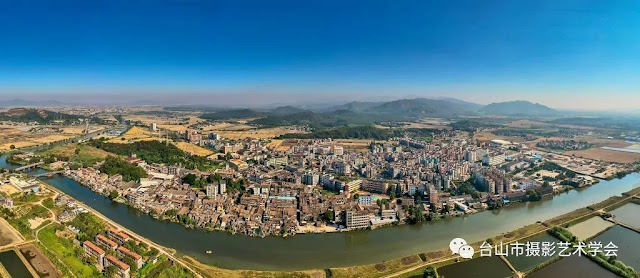
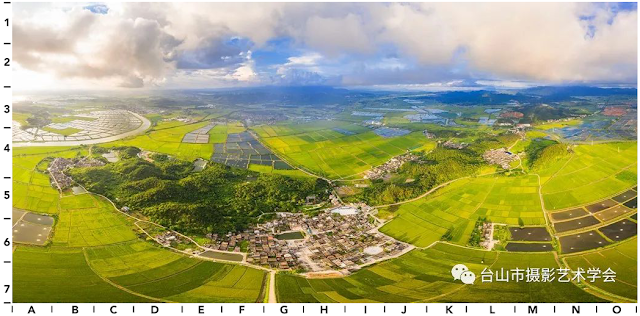
Doushan Township 斗山鎮 is one of the major market towns in Taishan County, Guangdong, China. My paternal grandparents, HONG Hock How and CHU Tui Goon, were from this area. My grandmother was from town itself, while my grandfather was born in Dong On village 東安村 just across the Doushan River 斗山河.

The city is surrounded by a vast area of fertile land, and boasts of a pleasant climate and beautify mountains and rivers. Known as the "No. 1 Overseas Chinese Hometown", Doushan is a tourist destination for the tens of thousands of overseas Chinese who hail from this area.

The Taishan Photographic Art Society recently published an exhibit of award winning photographs and videos of this area. Here are two of the photos showing Doushan and Dong On village:

Gold Collection Award:

A Bird's Eye View of Doushan Township by Xu Fangqun 徐方群

Award for Excellence:

[Heng River] Song of Earth and Wind + Doushan Heng River by Hu Sihong 胡思红

Doushan can be seen in the distance at C3 and D3. Dong On Village is at A3 next to the rice paddies inside graceful arc of the Doushan River. The area in the foreground is Yuet Wah 月華 and Heng Jiang Village 橫江村.

Zeng Laishun - The first Chinese to enroll at an American College

From the Hong 曾 Family's American Diaspora Files:

ZENG Laishun 曾來順 was the first Chinese to attend an American college. Laishun attended Bloomfield Academy, a boy's boarding school in New Jersey for three years. He then enrolled at Hamilton College in Clinton, New York in 1846. The women from the First Presbyterian Church in Utica, NY, were Laishun's sole source of support and refused to extend his funding beyond their initial two-year agreement. In May 1848, Laishun left New York and set sail for Hong Kong.

According to historian Edward J.M. Rhoads, “he was a pioneer in Western studies, an early and lifelong convert to Christianity, one of the first Chinese in the United States, a leading second-echelon figure in China’s self-strengthening movement, and, during his CEM [Chinese Educational Mission] days in the United States, a diplomatic representative of the Qing government as well as an explicator of things Chinese to the American public.”

The pioneering achievements of Zeng Laishun, America's first Chinese college student, have often been overshadowed by Yung Wing 容閎 (November 17, 1928 - April 21, 1912), who followed Laishun's footsteps by four years and is forever remembered as the first Chinese student to graduate from an American university, Yale College in 1854.

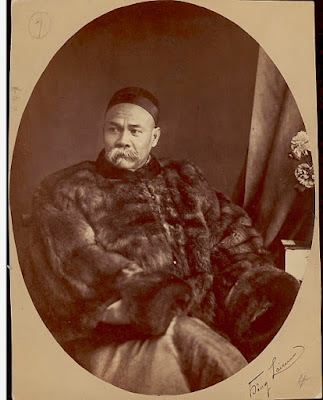
Zeng Laisun late in his career. From the Smithsonian Institution, United States National Museum,
Department of Anthropology, Division of Ethnology.

The Smithsonian misidentifies this photo as “Portrait of Li Hung Chang, Viceroy of Chilhli in Costume with Fur Cost n.d.” Researchers have asserted that the photo is of Zeng Laisun and not the Viceroy. Moreover, the photo is signed “Tseng Laisun” (which is the way Zeng spelled his name in his later years). The Smithsonian has declined to correct its catalog.

Asian American History is American History

Why I started this blog?

In 2001, I started researching my family's roots in the US and China, trying to uncover the stories of my ancestors. The post below is my first attempt to connect my family's story directly to the broader history of the United States. It focuses on how American laws and institutions have shaped the lives of my forbearers and continue to shape the lives of my family today. It's content was excerpted from the October 21, 2021, panel discussion on "Asian Perspectives on Race & Equity" presented to the public in Tredyffrin and Easttown Townships, Pennsylvania.

This is the history that I wish I had learned growing up, and that my children and all of our children should learn. It is only by learning about all aspects of our history that we can create a better future together.

You can read the transcript that follows or watch the 13 minute video on YouTube.

[The following transcript has been edited for concision and clarity.]

Zack ZENG Zhe - A September 11th Fallen Hero

From the Hong 曾 Family's American Diaspora Files:

On September 11, 2001, Zack ZENG Zhe 曾喆 was working at the Bank of New York at One Wall Street near the World Trade Center. When his building was evacuated, Zack could have gone home like the rest of his colleagues. Instead the 29-year-old gathered all the first aid and medical supplies he could find and told his friends and colleagues he was heading to the disaster scene to assist.

While attended the University of Rochester college Zack had worked as EMT with the Brighton Volunteer Ambulance. So, on 9/11, Zack was doing what he was trained to do.

Chin Bok Lain (1869-1938) - Unofficial Mayor SF Chinatown

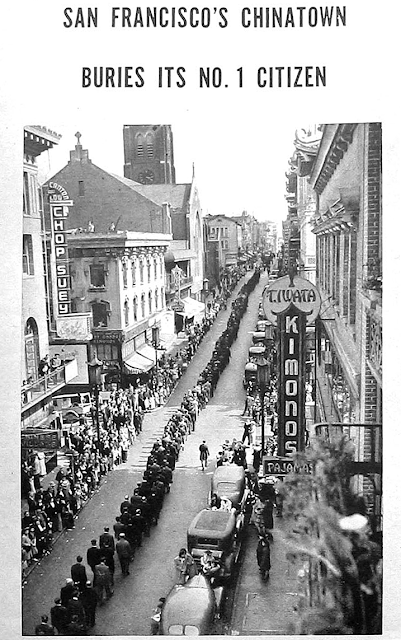
View from a Hang Far Low Restaurant balcony above Grant Street look toward
the corner of Sacramento Street and St. Mary's Cathedral on the left (Lee Rashall)
"Down the Street of Bazaars in San Francisco's Chinatown on July 31[, 1938], more than 1,300 mourners followed the body of Chin Lain to its last resting place. Son of Cantonese immigrants, the late Chin Lain lived to become a millionaire merchant, philanthropist and unofficial mayor of the greatest Chinese colony in the Western Hemisphere. Because the Chin family embraces the ranks of Chen and Chan, "relatives" of Chin Lain stretched in grieving files for six blocks behind the flower-filled phaeton which bore his picture at the procession's head (below). Observers said his funeral was the biggest, most dignified, Chinatown had ever staged." -- Life Magazine, August 15, 1938, page 14
Phaeton bearing portrait of Chin Lain (Lee Rashall)

The Burma Road (1938-1945)

The Chin Family's Greatest Generation

My grandfather CHIN Pak Yick, his first wife LEE Moon Yee, and my grandmother TSO Mee Shew raised what is arguably our family's greatest generation. This generation, the third generation of Chin's in the United States, all born in America, includes twelve of my mother's brothers and sisters who have over 190 years of combined U.S. Military and U.S. Government service. They served in Europe and the Pacific during World War II, in Korea, and in Vietnam. They also served with distinction at many levels of the U.S. civil service. All U.S. military service was completed with honorable discharges, and U.S. government service with retirement after many years of service.

Like most people, the Chin brothers and sisters were a product of their times. They came of age when many young men and women heeded the call to serve their country and fight fascism and authoritarianism abroad. They also grew-up at a time of segregation and exclusion in the United States when the federal civil service provided one of the best (and often only) opportunities for hard-working, dedicated minorities to make a good middle-class life for themselves and their families.

The Chin Family in the U.S. Military

My mother's eldest brother, Bruce Chin (1919-1988) served in the US Army during the invasion of Europe in World War II. He served three years with tours in Paris and Germany while both were under the boot of the Nazis. He was later assigned to General Dwight D. Eisenhower.

Bruce, Paris, 1946
Cover and Page from "Paris Under the Boot of the Nazis"
(From Collection of William Chin)


[Note: Willam Chin compiled this record of service to the United States for his generation with the help of his brothers and sisters and their children.]

The Gateway to Guangdong: Pearl Alley and the Plum Mountain Pass

The Pearl Alley or Zhujixiang 珠璣巷, Nanxiong is in Northeastern Guangdong province was a wealthy town across the border from Jiangxi province. As Han Chinese families migrated from the Central China to Guangdong, for many Pearl Alley was the first stop after traversing the Plum Mountain Pass or Meiguan Pass 梅關 through the Nanling Mountains 南嶺山. As such it could be consider to be the Ellis Island of Guangdong.

The Nanling mountains separate the Yangtse and Pearl River watersheds and are located at the junction of Guangdong, Guangxi, Hunan, and Jiangxi provinces. The mountain range elevation averages 3,000 feet with peaks as high as 6,000 feet. The ancient Meiguan road was first built in the Tang dynasty (618-907 CE) and covered the more than 75 miles between Ganzhou, Jiangxi 贛州江西, in the north and Nanxiong in the south. The road quickly became the main north-south trade artery and accelerated the shift of China’s economic center of gravity away from the central plains and toward the south. The pass was named after the numerous plum trees planted along the road.

North gate of Meiguan Pass with "South Guangdong Xiongguan" engraved over the arch, and "Plum Ridge or Plum Mountain Range" on the stone tablet. [Credit: Zhangzhugang – own work, CC BY-SA 3.0 https://commons.wikimedia.org/w/index.php?curid=33050221]

Oops! Mistakes in the Book

Oops!

History is not the study of cold facts but the interpretation of the past through available evidence. This evidence may include records of events (like a newspaper's recitation of who, what, where and when) or interpretations and analysis of those events (how and why). Both of those are subject to mistakes and bias. Many genealogies were lost in mass wartime migrations. With the social and financial importance of genealogies in traditional Chinese society, it also would not be surprising for some people to claim a more influential lineages to move up in society. Some genealogies were completely made up, with professionals going around using templates then fill in more information supplied by the clients. Other times overrun indigenous tribes in north and west of China wanted to blend in with Chinese society.

The Chin family genealogy, which was given to me by my maternal grandmother, has the following note on page 8:

Mistakes in the Book:

According to the Book to avoid the Jin chaos, the family's southern migration started with the move to Nanxiong 南雄 then to Gu Gang Zhou 古岡州. As the early migration was so long, there was no record of the exact time. According to legend, it was around 1266AD 咸淳二年. However, this was hearsay and not support by historical records. To find out the truth, the village elders were asked and they remembered the migration was about 1131 紹興元年. Between 1130 and 1266 is a difference of more than 140 years. Such a mistake! Therefore, the Book contains inaccurate information.

[Source: (穎川源記略 page 8, translation by Fonny Lau.]

These discrepancy may be attributed to poor record keeping or lost records during the times of war, chaos, and mass migration that occurred throughout Chinese history. But the self-acknowledge mistakes in the Chin book also points to the important aspect of historical records, which is that they may have conflicting facts and are not always reliable.

Our Ancestral Village Family Registries

In China, clans or kinship ties are based patrilineal groups of related people with a common surname sharing a common ancestor. In southern China, these ties were often strengthened by a common ancestral village or home, where clans had common property and a common spoken patois that was unintelligible to outsiders. Following Confucian tradition, each family maintained a registry, called a Zupu 族譜 in Mandarin, that contained the clan's origin stories and its male lineage.

The background image for this website is a composite of three pages from the Hong and Chin family registries. The left and center pages were hand copied by my paternal grandfather, Hong Hock How, from our ancestral village registry in Dong On 東安, China (Taishan County, Guangdong). Hock How used a booklet made of thin, translucent paper with a hand-stitched, stab binding. The page on the right is from the introduction to my mother's Chin family registry for our ancestral village Chazhou 槎州 (Taishan County, Guangdong). My copy appears to have been photocopied several times. It also had a hand-stitched, stab binding, which I removed in order to digitize the book, then re-stitched myself. It was given to us by my grandmother, but its author is unknown.

In Chinese tradition, the eldest person in the clan was giving the very important task of maintaining the clan's registry. When families settled in a new area, they would take a copy of the registry from their old village to use as the starting registry for their new branch of the family. As a result, family lineages in China can be traced back dozens of generations and thousands of years, at a minimum going back a clan's first ancestor to settle in a county or province, and often going all the way back to a China's mythical past.

Hock How was following in this tradition when he made a copy of of the Zeng Family Registry prior to his voyage to the United States in 1915. During the Chinese Cultural Revolution, many family registries were destroyed as relics of China's feudal past. Since China opened up in the 1980's, there has been a renewed interest in family genealogies as both local and overseas Chinese try to reconnect with their past. In some cases, family registries have been recreated from copies secretly hidden by village elders or preserved by the Chinese diaspora.

NPR Audio/Video Series: Where we come from?


For Immigrant Heritage Month, June 2021, NPR is releasing this series of videos and podcast episodes from Code Switch, Short Wave, and It’s Been a Minute. New content is being released through out the month. 
 
"Where are you really from? It's a question that immigrant communities of color across different generations are asked all the time. In this audio and video series, we take back the narrative and answer that question on our own terms, one conversation at a time — with family, friends and experts. These are our stories.” - NPR.org

Check it out: https://www.npr.org/2021/06/01/996412589/where-we-come-from


The Southern Chen Dynasty (557-589)

Northern & Southern Dynasties – Chen Dynasty南陳朝(557-589)

The Chen dynasty was the fourth and last of the Southern dynasties in China. Following the Liang dynasty, it was founded by Chen Baxian, an 18th generation descendant of Ying Chuan Chen Clan founder Chen Shi. The Chen dynasty covered most of China South of the Yangtse River 長江


Chen Emperor

Personal Name

Posthumous

Birth – Death

Reign

First

Ba Xian霸先

Wu Di武帝

503-559

557-559

Second

Qian

Wen Di 文帝

522-566

559-566

Third

Bo Zong 伯宗

Fei Di 癈帝

554-570

566-568

Fourth

Xu

Xuan Di 宣帝

530-582

568-582

Last

Shu Bao 叔寶

Hou Zhu 後主

553-604

582-589